Beyond the NVIDIA GPU: Nvidia's $4.7 Trillion Networking Bet
Nvidia, the GPU titan, is investing big in AI networking as China sales stall, building complete AI factories. Is this their next growth engine?
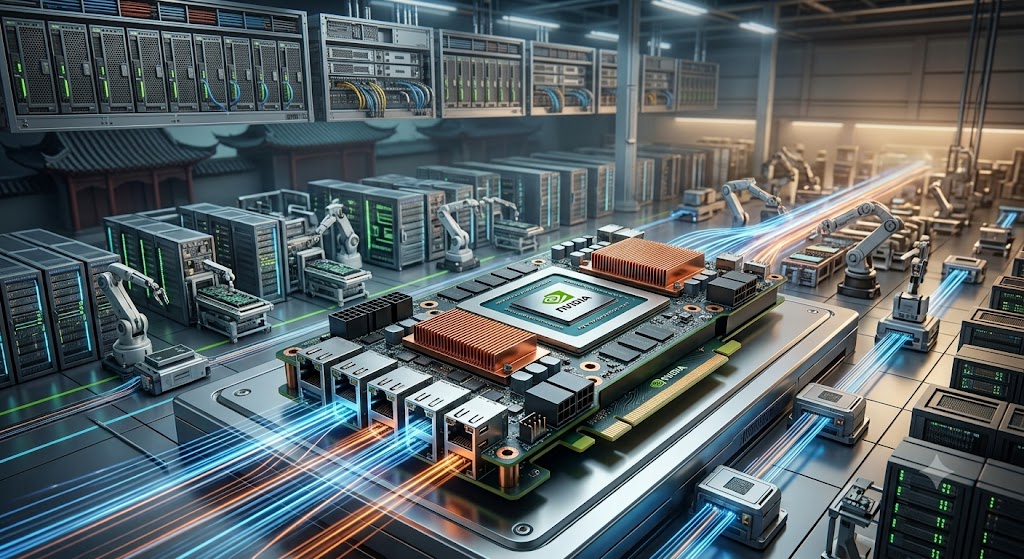
NVIDIA, the company behind the graphics processing unit, is making a bold move. Forget the silicon powering your AI models for a moment. Jensen Huang and his team are investing heavily in a new market - one they believe could be worth a staggering $4.7 trillion. No typo. And it has nothing to do with another NVIDIA GPU.
We're talking AI networking technologies. Late November 2022, Nvidia doubled down on this pivot. It's not just about selling more chips - it's about building "complete AI factories." Serious compute is crucial, but how that compute talks to itself, how data flows at light speed between racks... that's becoming just as critical. Nvidia's bet is that networking gear isn't just a complement; it's the next frontier. For hyperscalers, that means accelerating their infrastructure budgets.
What’s the next big thing after the NVIDIA GPU?
Nvidia's strategy: position themselves as a key provider of the entire AI factory. That means pouring resources into AI networking - InfiniBand, high-performance interconnect standard, and newer Ethernet switches like their Spectrum-X line. BlueField data processing units, or DPUs, offload networking and security tasks from the main CPUs, freeing up resources for AI workloads.
Silicon photonics and optical interconnects. Critical for moving massive amounts of data within a data center faster and more efficiently than traditional copper cables. Companies like Coherent and Lumentum are in Nvidia's sights. The goal: cut the cost of AI infrastructure down to $1,000 for every $2 billion saved in data processing over a decade.
But what's driving this push?
It's a strategic move, especially when you look at certain market challenges. Case in point: China. Nvidia's AI chip sales there are stalling - a big problem for any company with global ambitions. Local chipmakers, most notably Huawei, are taking the lead. This points to a deeper trend of domestic capabilities maturing.
Why are NVIDIA GPU sales struggling in China?
When a major player like Nvidia sees its dominance challenged in a region as critical as China, it forces a re-evaluation of where the next growth engine will come from. If you're an IT manager building out a global AI infrastructure - this matters. Regional variations in available hardware might become more pronounced, and relying solely on one vendor's chip roadmap might not be the smartest play. The market for high-end NVIDIA GPU hardware isn't a guaranteed one-way street anymore. Especially in places where local alternatives are strong. So, what's the alternative?
You'll need to diversify your hardware sources. That's a challenge.
Is Micron stock the new NVIDIA GPU equivalent?
The market is always looking for the "next big thing" - that stock that explodes like Nvidia has. Micron stock is now being floated as a potential equivalent to Nvidia’s incredible run. What does that tell you? Investors see Nvidia’s current valuation and look for companies with similar potential for explosive growth - even if their core businesses are entirely different. Micron, a memory chip giant, isn’t building AI factories or high-end graphics cards. The comparison shows the hunger for companies positioned to ride the AI wave. But can Micron deliver?
This search for the "new Nvidia" reflects the existing Nvidia’s phenomenal success with its GPU business - but it also hints at the market's underlying question: where does Nvidia go from here? If its primary engine – the NVIDIA GPU – faces headwinds, what’s the backup plan? For Nvidia, the answer seems clear: it’s the infrastructure around the GPU. They're moving from being a component supplier to the architect of the AI data center. And that means...
A lot of changes.
What does this mean for you - whether you’re a developer, an IT manager, or a CTO? Keep an eye on the networking stack. Nvidia isn't just selling you a better chip; they're selling you a whole factory. That means integrating their Spectrum-X Ethernet switches, their BlueField DPUs, and their optical interconnects into your existing or planned infrastructure. The implications are huge: networking gear could soon be as tightly coupled to your compute strategy as the compute itself. Watch for more partnerships and acquisitions in the silicon photonics space. The future isn't just about raw GPU power; it's about how quickly and efficiently that power can communicate - and that's a whole different story.